Primary 2018 I Know Jesus Christ Will Come Again
Jesus Christ is the designation of Jesus of Nazareth (d. c. thirty CE), who was an itinerant Jewish prophet from the Galilee in northern State of israel. He preached the imminent intervention in man affairs by the God of the Jews, when God would establish his kingdom on earth. The proper name Jesus was Greek for the Hebrew Joshua ("he who saves"). 'Christ' (Greek: Christos) was translated from the Hebrew meshiach (messiah). 'Messiah' meant "all-powerful 1" where anointing was office of the coronation ritual by God for Jewish kings. "Jesus the Christ" became shortened over fourth dimension to Jesus Christ, beginning with the letters of Paul in the 50s and 60s of the 1st century CE. A pop title became his designation equally the "son of God", both in part and nature.
Historical Context
The Jews were an indigenous group of various tribes who lived mainly in Israel but besides settled in communities around the Mediterranean Basin. Collectively, they were known as the nation of Israel. They shared many religious elements with their neighbors only differed by having distinct dietary laws, practicing circumcision, and observing Sabbath (a day of rest every vii days). The other major difference was that while recognizing the various deities in the universe, they were only permitted to offer sacrifices to their God. This was done at the Temple complex in Jerusalem.
Over the centuries, the Jews had suffered the Assyrian Invasion (722 BCE), the destruction of Jerusalem and the Temple past the Babylonians (587 BCE), the occupation by the Greeks (167 BCE), and so Rome. When the Roman general Pompey (106-48 BCE) conquered the Due east, including Israel (63 BCE), he established client-kings who were responsible for keeping the peace, carrying out Roman dictates, and collecting taxes. Herod the Great was named King of the Jews (r. 37-4 BCE), and although he renovated the Temple complex in Jerusalem, he was reviled by many for his relationship with Rome.
Jewish prophets claimed that God would intervene in history one final fourth dimension & raise up a messiah to lead the armies of God against Israel'due south oppressors.
Traditionally, the books of Jewish prophets (oracles) had blamed these events on the sins of the people, largely idolatry (worship of other gods). Yet, these prophets also offered a bulletin of promise, known equally Jewish Restoration Theology. They claimed that at some time to come time, God would intervene in history one final time to restore the nation of Israel and God would heighten upwards a messiah to atomic number 82 the armies of God against Israel's oppressors.
By the 1st century CE, there were many Jewish groups (sects) that maintained the traditions of Israel but varied in their lifestyles and mental attitude toward Rome and infamous for their debates among each other. Israel produced several charismatic messiah claimants, all calling for God'south intervention against Roman dominion. These men stirred up the crowds during religious festivals in Jerusalem, calling on God to destroy the Romans and found his kingdom. Rome's response was to arrest and execute both the leader and his followers. The usual method of execution was crucifixion, the Roman punishment for treason as preaching a kingdom that was non Rome threatened the prosperity and stability of the Roman Empire.
The followers of Jesus of Nazareth became one more sect of Jews among many at the time. During the 20s CE, he proclaimed the bulletin: "Repent, for the kingdom of God is at hand" (Mark 1.15). The merits was presented every bit "good news"; thus the afterwards Anglo-Saxon term of 'gospel'.
The Dates for Jesus
Simply 2 gospels, Matthew and Luke, present a nativity story, or the details surrounding the nascency of Jesus. The dates are problematic. Matthew claimed that Jesus was born roughly ii years earlier the death of Herod the Corking (four BCE), while Luke claimed he was born during the governorship of Quirinus in Syria (6 CE). Both relate that his female parent, Mary, was impregnated by the spirit of God, resulting in the virgin nascence.
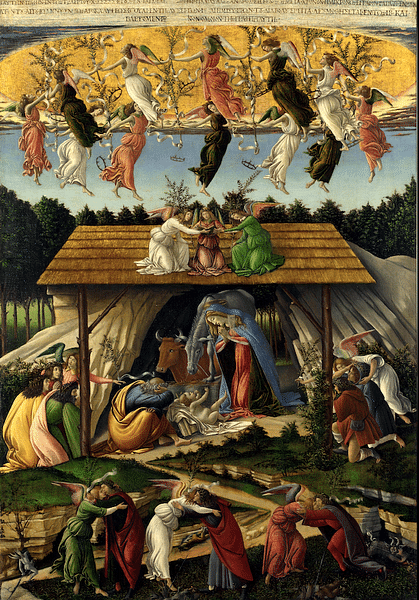
Mystic Nativity by Botticelli
All the gospel writers identify the ministry building and death of Jesus during the reign of the Roman procurator, Pontius Pilate. We know that Pilate reigned from 26-36 CE. Past agreement, the mutual date for the expiry of Jesus falls between 30-33 CE.
The Ministry of Jesus in the Gospels
The ministry of Jesus began after he was baptized by a man known as John the Baptist. Baptism only meant dunking. John was symbolically utilizing a water ritual after someone had repented of their sins. The ritual of baptism was i of the earliest Christian rituals and became part of the initiation of believers to enter the community.
He called twelve disciples (students) to found his inner circle, symbolizing the restoration of the twelve tribes of State of israel.
Mark (the earliest gospel, c. lxx CE), presented Jesus as a charismatic exorcist, an itinerant preacher understood to have special gifts from God, operating through God's spirit, similar the Prophets of Israel. Mark'due south Jesus traveled through the pocket-size towns and villages of Galilee, bringing his message that the prophets' prediction of the terminal days was imminent. According to Mark, Jesus taught through parables, which utilized everyday concepts and details to teach through examples. He called twelve disciples (students) to institute his inner circle, symbolizing the restoration of the twelve tribes of Israel.
Commencement with Mark, the gospels relate that the Jewish leadership (mainly the Pharisees, scribes, and ultimately the Sadducees who were in accuse of the Temple) was opposed to the teachings of Jesus from the very kickoff of the ministry. Jesus and his disciples traveled to Jerusalem to celebrate the Passover festival. Jesus then went to the Temple Mount and disrupted the services of the brute-sellers and the money-changers. According to Mark, it is this event that led to the death of Jesus. Later celebrating the Passover repast (which would become the Christian ritual of the Last Supper), Jesus and the disciples walked to the Mount of Olives to pray. Mark related that information technology was in that location that one of his disciples, Judas, betrayed Jesus to the Jewish government so that he was arrested.
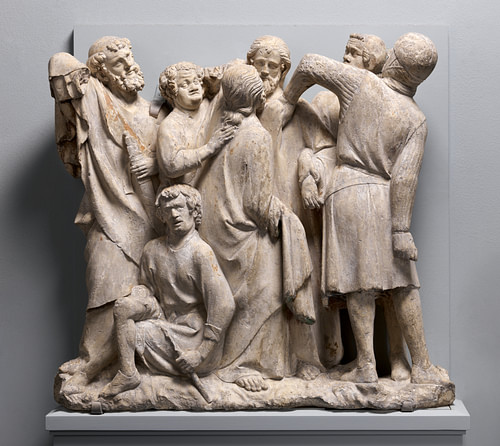
Relief of the Betrayal and Arrest of Jesus
The gospels report a series of evening and morning trials in front of different groups (the Sanhedrin, the ruling Council of Jerusalem, the loftier-priest), and Jesus was condemned for blasphemy. Jesus was innocent of this charge, but the gospel writers knew how Jesus died and used blasphemy as a plot device to hand him over to Rome.
Jesus was executed on a Friday afternoon. Sat was the Sabbath, which began at sunset on Friday, and and so the women could non go to the tomb until Sun forenoon to stop the funeral rituals. It was and so that his followers claimed that the trunk of Jesus was gone, that he had been raised from the expressionless by God. In consequence, the claim was fabricated that Jesus was actual ascended into heaven.
Jesus of Nazareth every bit the Messiah
All four gospels had to deal with some problems in their claims that Jesus of Nazareth was the promised messiah of the Jewish Scriptures. Not only was Jesus dead, but he died by crucifixion, as a traitor to Rome. And the preaching of the imminent kingdom of God had non materialized. Two responses arose in the communities of his followers. In capacity 53-54 of the Prophet Isaiah, we accept the clarification of a "righteous servant" who is tortured, suffers, dies, and then is elevated to share the throne of God. In the historical context of the Prophet Isaiah, the suffering retainer stood for the nation of Israel. Early Christians now claimed that Isaiah was predicting that Jesus of Nazareth was this suffering servant.
The trouble of the fact that the kingdom of God did not materialize when Jesus was on earth was resolved past some other Christian innovation. This is known as the parousia or 2d appearance. Jesus, now in sky, would return at a future engagement, and and then the remaining elements of the reign of God would be manifest on earth. This confidence remains central to Christianity, where the details were outlined in the Book of Revelation by John of Patmos.

The Crucifixion by David
The followers of Jesus took his bulletin to the cities of the Empire. Surprisingly, Gentiles (non-Jews) wanted to join. Initially, a fence arose over whether they should fully catechumen to Judaism commencement (circumcision, dietary laws, and Sabbath observance). The decision was made c. 49 CE in Jerusalem against this requirement. But they did have to follow Jewish incest laws, consume no meat that had blood in it, and cease idolatry to the traditional gods of the Roman Empire. Preaching against traditional Roman religion later led to the persecution of Christians by the end of the 1st century CE.
Afterward receiving a vision of Jesus (now in sky), Paul, a Pharisee, joined the move and began preaching "the skilful news" in various cities in the Eastern Roman Empire. Within the historical context of Paul's communities, notwithstanding, this was not a new religion. This was Judaism with a twist. Paul established two-tiered communities fabricated up of Jews and Gentiles, only both believing in the fulfillment of eschatological teachings of the Prophets. Much of his advice in the messages was directed toward the followers of Jesus in terms of how to live in the interim before he returned to earth. Paul expected his generation to be the last of the erstwhile club until the transformation of the universe took identify through Christ.
The Worship of Jesus as God
It is in Paul'south communities that we notice the earliest evidence that Jesus of Nazareth was at present being worshiped along with the God of Israel (as sharing the throne of God). This worship consisted of prayers and hymns to Jesus, baptizing in his proper name, exorcising demons in his proper noun, and commemorating his death past coming together together each week to call up the Concluding Supper. As Paul said, "every genu should bend" before Jesus, the age-old ritual of veneration to a god.
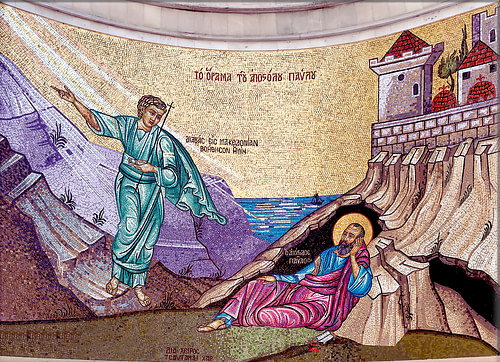
Apostle Paul Mosaic
In Paul'south letter to the Romans, we find the offset reference to what would constitute the agreement of the death of Jesus equally atonement. Amende referred to a sacrificial ritual that would fix or absolve for a violation against a commandment of God. In Romans 5, he practical the analogy of "first human being, concluding human." Adam, the beginning man, sinned, and his punishment was death for his descendants. Jesus, the last man, died and brought eternal life. This became understood equally the rationale for the death of Jesus of Nazareth: Jesus died non simply for our sins but for the penalisation of our sins, concrete death. To be saved through faith (loyalty) to Jesus, meant that when Jesus returned, his followers would be transformed into spiritual bodies (no longer mankind) and co-rule with Christ on world (i Corinthians fifteen). After the offset generation did indeed die, the concept was adjusted to the thought that though we would continue to die, notwithstanding, believers could relish an afterlife in heaven.
In the eye of the second century CE, Christian leaders (mostly bishops) later designated every bit Church Fathers, began writing apologia to Roman Emperors and others in defense of Christianity. As educated men in diverse schools of philosophy, they utilized philosophical concepts of the universe and terminology to accordance Christian views of Jesus with philosophical claims. Thus, the elevation of Jesus of Nazareth from a Jewish wonder-worker to a source of all power in the universe.
Sources for the Life & Ministry of Jesus
The gospels were non written by the disciples of Jesus & they existed for about a hundred years before afterwards Christians assigned names & authorship to them.
We have no gimmicky sources for the life of Jesus and his ministry building; no one at the fourth dimension wrote anything downward. Contrary to popular belief, the gospels were not written by the disciples of Jesus. In fact, the gospels existed for about a hundred years earlier later Christians assigned names and authorship to them. The immediate groundwork for the gospels was the Jewish Revolt confronting Rome (66-73 CE), which concluded with the devastation of both Jerusalem and the Temple. This was somewhen blamed on the Jews collectively, as a punishment for their rejection of Jesus as messiah. Gospel writers distinguished between their Jews and rebels by presenting the death of Jesus was as a outcome of religious differences with the Jewish leadership. Having a Roman magistrate declare Jesus innocent meant that, by implication, his followers were innocent of treason as well.
The earliest not-Christian sources for Jesus are found in the works of Flavius Josephus (36 - c. 100 CE), a Jewish general during the Revolt. He changed sides and later on moved to Rome to write several volumes of his history of the Jews. Preserved by Christians, these works related the story of the death of John the Baptist (different than Mark'due south version) and the execution of James, Jesus' brother in the yr 62 CE. There is as well a controversial passage known as the Testimonium Flavianum. The Testimonium acknowledges Jesus equally the Christ just remains controversial as nowhere else in his writings is Jesus mentioned once again. Scholars debate if this section was added by a subsequently Christian.
The kickoff Roman sources come from subsequently writings. Pliny the Younger (governor of Bithynia on the shores of the Black Ocean) wrote about Christian trials c. 110 CE. The historian Tacitus (writing around 110 CE, followed past Suetonius, c. 120 CE), related the story of Nero'south (r. 54-68 CE) persecution of the Christians in Rome afterwards the not bad burn in 64 CE.
Christianity as Legal Faith
For roughly 300 years, the Christians were persecuted by Rome for angering the gods. In 312 CE, Constantine I (r. 306-337 CE) battled other contenders for the championship of Emperor of the Western Roman Empire. He won at the Battle of the Milvian Bridge in Rome and credited the victory to the
God of the Christians. Christianity was now a legal religion through the Edict of Milan in 323 CE, no longer subject area to persecution.
During all this fourth dimension, in that location was no central authority such as the Pope in the later Vatican to determine standard Christian beliefs and rituals; communities literally followed the teachings of their leaders (now bishops) and continued to argue with each other. When Constantine the Slap-up converted, he opted for the teachings of the Church Fathers which would ultimately go the standard theology of Christianity.
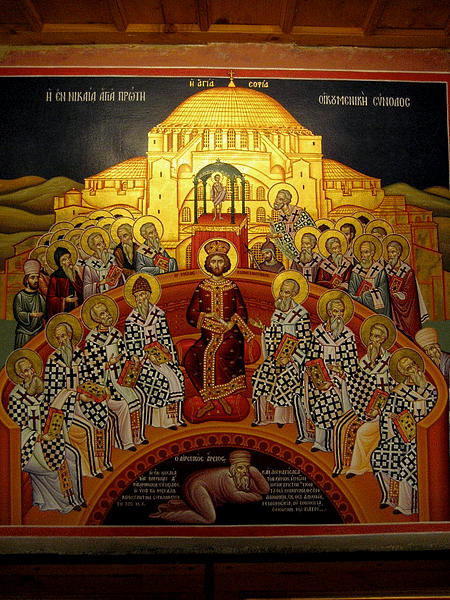
First Council of Nicaea
Effectually 325 CE, Christian communities were debating - sometimes violently - the relationship between Jesus and the God of Israel. Constantine called for an ecumenical meeting at Nicaea in mod-twenty-four hour period Turkey to settle the issue. The outcome of this meeting was another innovation, the Nicene Creed, that all Christians were to believe. Retaining their inheritance from Judaism, the God of Israel was the greatest god but at present was to be worshiped simultaneously with Jesus as the identical essence of God, along with the spirit of God (the Holy Spirit); this concept became known equally the Trinity.
I final element was resolved at the Council of Chalcedon in 451 CE. This involved the man or divine nature of Christ. After a serial of debates, leaders met to decide the issue and alleged that Jesus was of ii natures, simultaneously human and divine. The two natures never impinged upon each other; they remained unique and distinct elements of Jesus of Nazareth.
Modernistic Christianity
In 1053 CE, Christian churches in the Eastern Empire and Western Empire split over doctrinal differences. The Eastern churches are collectively referred to as Orthodox communities. The Byzantine emperor in Constantinople was the supreme head of these communities until the Muslim conquest in 1453 CE under the Ottoman Turks.
In Western Europe, the medieval Church building was dominated by the Vatican, headed by the Catholic Pope in Rome. In 1519 CE, an Augustinian monk past the proper name of Martin Luther rejected many of the rituals and beliefs of this system and created what became the Protestant Reformation. Luther focused on faith alone as the way to private salvation.
During the period of colonial expansion, Christian missionaries took the teachings of their various communities to Cathay and Nippon, Africa, and the Americas. Today, Christianity is one of the largest of the world's religions at c. 1.three billion adherents. While living in a secular world, our calendar nonetheless remains highlighted by Christian holidays that re-enact events from the life of Jesus.
This commodity has been reviewed for accuracy, reliability and adherence to academic standards prior to publication.
Source: https://www.worldhistory.org/Jesus_Christ/
0 Response to "Primary 2018 I Know Jesus Christ Will Come Again"
Postar um comentário