Walter Benjamin the Work of Art in the Age of Mechanical Reproduction
"The Work of Fine art on the Historic period of Mechanical Reproduction" past Walter Benjamin was published in 1936, the inter war period. "Having experienced Fascism and the fascist use of media in Federal republic of germany" [from Media & Cultural Studies Keyworks ed. by Durham and Kellner] Benjamin speaks to the transformation of the Marxian superstructure which he observed "has taken more than a half century to manifest in all areas of civilisation the change in the conditions of product". Reflecting on the part of art in the 20th century, he explores a theory of art and the "useful formulation of revolutionary demands in the politics of art." [Preface] Since first reading this essay 15 years ago, I've always been struck past its prescience and continual resonance in the digital age, so please forgive the length of this provocation beyond the recommended two-3 paragraph blog post.
Benjamin asserts that the work of art has always been reproducible, but is quick to point out that mechanical reproduction, i.e., Marxian Capitalist mechanistic reproduction, through photography and film, represents something new. Benjamin discusses the profound repercussions that reproduction of works of art through photography, and the 'art of the film' have had on art in its traditional form. [Section I] Given this context, what are your thoughts on Benjamin's statement that "even the nearly perfect reproduction of a piece of work of fine art is lacking in one element: its presence in time and space, its unique being at the place where it happens to be," or in Benjamin-ian terms, its "aura". [Department II] Benjamin further clarifies and defines the term "aura" of the work of art every bit "that which withers in the age of mechanical reproduction". Do you hold or disagree?
For this provocation, I'll use an example from art: does Leonardo da Vinci's Mona Lisa cease to exist the Mona Lisa if we remove her from the rooms in which Leonardo painted and her patron intended her or the Louvre where she has resided for many centuries and withal resides today? For example, more specifically, an enlarged and interactive Mona Lisa is currently on brandish in the windows of fashion conglomerate LVMH at 5th Ave. and 57th Street and she fifty-fifty winks. She is featured in a drove of luxury leather products designed by artist Jeff Koons entitled "MASTERS" that retails for approx. $585.00 – $4,000.00. Here's a recent photograph of the display:
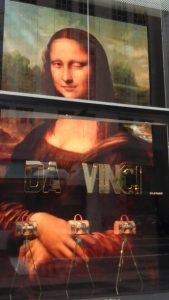
Mona Lisa is besides currently on display at my local mall via a jacket design: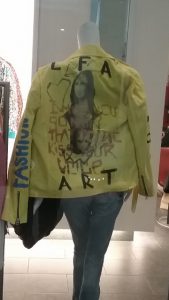
Do you think such reproduction erodes, or conversely, enhances the Benjamin-ian aureola of this work of art?
Benjamin attributes social bases for the "contemporary disuse of the aura" and that these "residuum on two circumstances, both of which are related to the increasing significance of the masses in contemporary life." [Department Three] What are your thoughts on this?
While the contemporary cult of the Mona Lisa carries on in our modern mode world today, Benjamin states that "originally, the contextual integration of fine art in tradition found its expression in the cult" and he clarifies, "in other words, the unique value of the 'authentic' work of fine art has its basis in ritual, the location of its original use value" and he proceeds with "an all-important insight: for the first time in earth history, mechanical reproduction emancipates the work of fine art from its parasitical dependence on ritual." Benjamin then points out a paradox that "to an ever greater caste the work of fine art reproduced becomes the piece of work of art designed for reproducibility." Cautioning, he qualifies this with: "But the instant that the criterion of authenticity ceases to exist applicable to artistic product, the total role of art is reversed. Instead of beingness based on ritual, it begins to be based on another practice – politics." [Section IV] Practise you recall the mail service-millennial role of fine art is one of ritual, politics or both? Tin you cite examples of works of art to illustrate your point of view?
The Net, and our use of it, are for u.s.a., in my opinion based upon Benjamin, the ultimate mechanical reproduction of fine art and exhibition infinite (another important concept to Benjamin). Acting every bit the mass which "is a matrix from which all traditional behavior toward works of art issues today in a new form" [Section 15] the Internet's inherent mechanical reproduction is the ultimate emancipation of art, and I'd add, also its paradoxical enslavement of fine art to the new rituals of clicking, copying, pasting, scanning, uploading, downloading, swiping, posting, re-posting, tweeting, re-tweeting, liking, favorite-ing and deleting.
While it is easy for me to grasp the deposition of the Benjamin-ian aura in the work of art, because all one has to practise is photocopy the Mona Lisa from an fine art book or copy information technology from a website and encounter the loss of resolution and aesthetic quality with each generation, 1 must ask rhetorically how Benjamin foresaw this without the benefit of Xerox, Photoshop, the World Wide Web, apps such as Instagram and filters. Do y'all find "The Work of Art in the Age of Mechanical Reproduction" as forrad thinking every bit I do? Does information technology hold up in the digital age?
I cannot overlook that this provocation is assigned and intended for the readings for our Sept. 11 form, and it brings to mind some remarks made past the author of "Prozac Nation" Elizabeth Wurtzel. They struck me then and all the same do at present, equally reminiscent of the Epilogue in which Benjamin theorizes that war is the ultimate work of art. Wurtzel was asked most the events of Sept. 11, 2001 in Feb 2002 during an interview to promote her volume More, At present, Once again by the Toronto Globe and Mail in the context of her residency close to the World Trade Heart, and she commented as follows: 'I had non the slightest emotional reaction. I thought, this is a really strange fine art projection…it was a nigh amazing sight in terms of sheer elegance. Information technology fell like water. Information technology just slid, like a turtleneck going over someone'southward head.' (Her comments set off a shock wave and likely acquired her movie for "Prozac Nation" made past Miramax not to exist released.) For me, these comments brought to mind words of Benjamin I have difficulty typing and relaying that "state of war is beautiful" and that "through gas warfare the aura is abolished in a new way." Writing in his fourth dimension and place, Benjamin quotes Fascism "Fiat ars – pereat mundus" (translation: let art be created, though the globe perish) which was the Fascist spin on "fifty'art pour l'fine art" (art for art's sake) and concludes by conjecturing "state of war to supply the artistic gratification of a sense of perception that has been changed by technology." [Epilogue] Do you find this to exist the logical and likely post-Marxian development?
Related Video Prune: Does this video of LVMH's Titian window (item from the painting of Mars, Venus and Cupid) decay its aura or enhance it?
Related Resources:
"Jeff Koons's New Line" by Vanessa Friedman, The New York Times, April eleven, 2017
"The Louis Vuitton x Jeff Koons Bags May Be My Least Favorite Designer Collab Ever" by Amanda Mull on purseblog, April xiii, 2017
"Release Me" past John Harris, The Guardian, July 17, 2004
"Mona Lisa & an Iguana on 5th" past Carolyn A. McDonough, on CultureArtMedia, September 1, 2017
Source: https://itpcore1fall2017.commons.gc.cuny.edu/2017/09/07/the-work-of-art-in-the-age-of-mechanical-reproduction-by-walter-benjamin/
0 Response to "Walter Benjamin the Work of Art in the Age of Mechanical Reproduction"
Postar um comentário